Published by Sue Johns-Chapman
Published Date 06.10.2026
Published by Sue Johns-Chapman
Published Date 06.10.2026 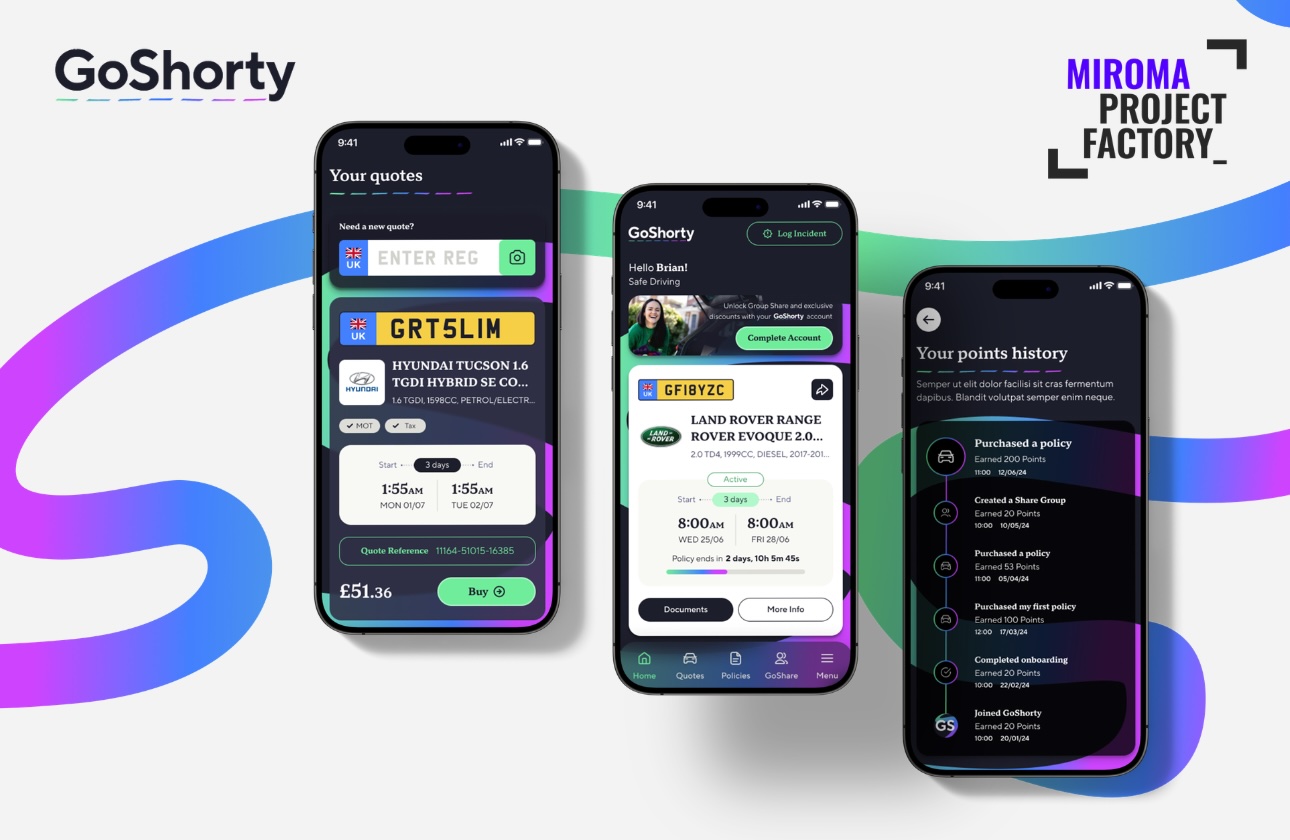
App engagement is often measured by the number of sessions, dwell time, interactions, and time spent, with the assumption that ‘more is better’. But what if the best digital experience is one that helps people leave faster? This question is central to the GoShorty app, which was recently named a finalist in the 2026 Global Digital Excellence Awards.
GoShorty provides short-term car, van and learner driver insurance in the UK. In the UK, insurance cover is specific to the driver and vehicle combination, meaning someone borrowing a car is not automatically covered simply because the vehicle itself is insured. It is therefore a product people often need immediately, and in the moment: borrowing a car, practising as a learner driver, collecting a vehicle, or needing temporary cover at short notice. In these situations, customers tend to be on-the-go with only their mobile to hand, and they want to secure coverage quickly, ensure everything is in order, and proceed without delay.
So when GoShorty partnered with Miroma Project Factory (MPF) to develop a cross-platform Flutter Application for both iOS and Android as a new channel for their existing browser-based experience, the challenge was not to keep someone engaged with it for a long time. Rather, it was to deliver a solution so useful, intuitive, and familiar that repeat customers would naturally return when they needed temporary coverage again, simply because it was so quick to use. This approach required a particular approach to understanding what really makes an app ‘sticky’, and in what ways that is relevant to the task at hand.
Design for the behaviour that matters
At MPF, behaviour change is central to our approach to digital product design and development. We begin by identifying the desired user behaviour: what prompts action, where friction occurs, what builds confidence, and how to make the desired action easier to repeat. In many of our behaviour change products within the health and wellbeing space, deep engagement and interaction is central to that idea.
For GoShorty, the key relevant behaviour was repeat purchase. The business already offered a highly optimised web experience and had a strong base of returning customers. However, these customers often restarted the digital process by searching for GoShorty, sometimes clicking through paid ads, and beginning a new web journey. As a result, GoShorty was effectively paying to reacquire existing, already loyal customers.
The app provided an opportunity to shift from individual transactions to a direct and ongoing relationship with customers. The design principle to achieve this was straightforward: every successful interaction should make the next one easier.
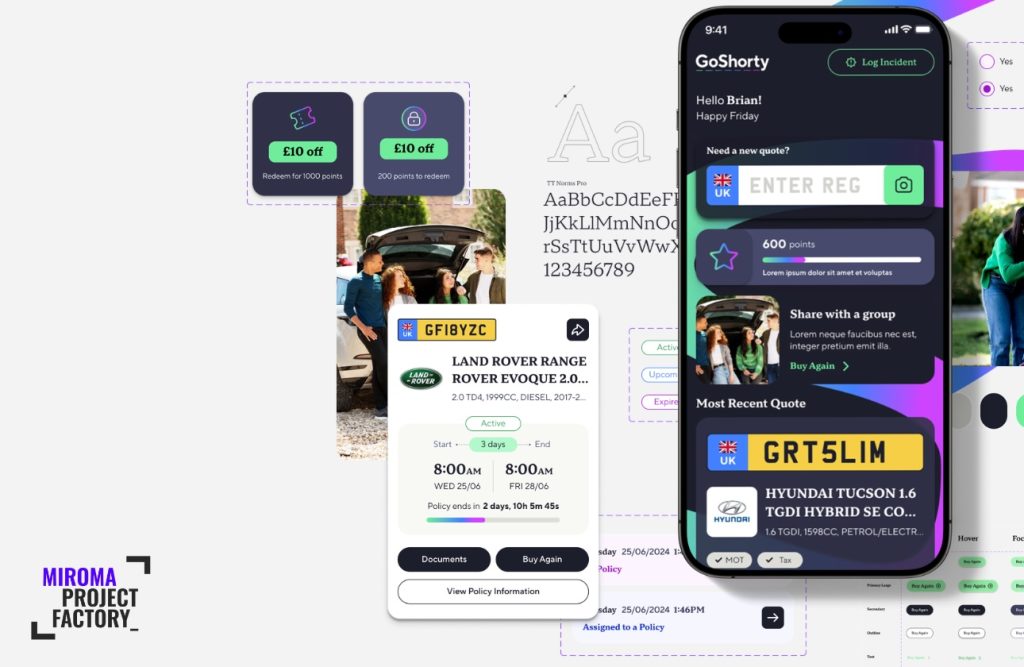
We reached this result by introducing measures that cut down on unnecessary decisions and obstacles. The system was designed to remember driver and vehicle details in order to eliminate the need for repeated entries, to enable access to earlier policies and documents, and to shorten the process as a result of customers making repeat purchases. The system sends timely reminders when another need occurs and also includes loyalty rewards to add value for customers who return. For a product operating in a highly regulated industry with deep integrations with external insurance and lookup databases, the value, therefore, lies in how these features work together to reduce effort, build familiarity, and make the desired behaviour easier to repeat.
Less time in the app, more reason to return
‘Sticky’ digital products are usually associated with increased content, more interaction, or features designed to extend dwell time. But some of the most valuable products on our phones work differently. We keep them because they reliably solve a specific problem, and when that need arises, we know exactly where to go. Insurance itself may not naturally fall into this category, but the circumstances that lend itself well to the need for temporary insurance is a clear example of where this principle can be appropriately applied in a new way.
A customer may be standing beside the car they need to drive, arranging learner cover before a lesson, all actions that require insurance at short notice. At that moment, any unnecessary field, screen, or decision introduces friction when it is least welcome.
The objective, therefore, was to move beyond replicating GoShorty’s website within an app to intentionally leverage mobile capabilities for its particular role: retaining context, storing information, reducing repeated effort, and providing a direct route back to the service. The immediate interaction becomes shorter, through which the customer relationship is strengthened.
The behaviour is evidenced in the results
The results make that distinction clear:
- GoShorty initially targeted the app to account for 10% of the business. It has since more than tripled that original goal.
- Customers who initially purchase through the website are much more likely to purchase again after transitioning to the app.
Importantly, this growth has not introduced additional service friction. GoShorty has recorded next to zero app-related issues, complaints, or customer service calls, while customer ratings remain at 4.9 on the Apple App Store and 4.8 on Google Play.
As GoShorty reflected a year after launch:
“Our app now accounts for significantly more than a third of our business, significantly exceeding our year one targets and expectations. We’re very proud of what we’ve created together […] we can confidently say that we’re operating with a market-leading app that is already transforming our business.”
– Graeme Stoker, Director of Marketing, GoShorty
The wider GoShorty app case study explores the strategy, design and development behind these results.
These figures provide a more accurate measure of meaningful engagement than session duration. Customers do not need to spend additional time with GoShorty, they simply need to choose it again.
Does every business need an app?
As app development becomes more accessible, this question is increasingly relevant – does my business need one?
For an app to be successful, it can’t exist solely because it is possible to build one. It lives on a user’s device, takes up part of their life, and must earn its place. This is achieved when an app offers meaningful advantages over other channels, such as retaining context, reducing repeated effort, responding to specific moments, or fostering a more valuable ongoing relationship between business and customer.
It also requires a clearer definition of what ‘engagement’ means or is valued as, within the context. For some products, time spent is important. For others, success may be measured by progression, participation, sustained interaction, or adherence.
For GoShorty, meaningful behaviour is straightforward: customers return when they need insurance and complete the transaction with minimal effort.
The point isn’t that mobile should replace the web. Different behaviours can and should coexist across channels. For example, in banking, people often check balances or make quick payments on their phones, but prefer desktops for mortgages, investments, or complex financial decisions. The value lies in understanding which behaviour belongs where – and designing each channel around that moment.
This principle guides all of MPF’s work – identify the key behaviour, then design the experience to make it easier to adopt and repeat.
Being named a finalist in the 2026 Global Digital Excellence Awards is a welcome recognition for GoShorty, MPF, and the teams behind the product. The recognition adds to a growing list for the app, including a 2026 Web Excellence Award win in Apps & Mobile – Finance; a Webby Awards Honoree in Fintech, Financial Services & Banking; and finalist recognition for Standout App at the 2026 UK Digital Excellence Awards. However, the clearest recognition is reflected in customer behaviour – they are returning.
Digital products do not need to demand more attention to increase their value. Sometimes, the most effective way to make an app sticky is to make it exceptionally easy to leave.